

The Serengeti National Park is easily Tanzania’s most famous national park, 14,763 square kilometres of protected area that borders Kenya’s Masai Mara Game Park. Serengeti National Park is famous for the annual 'great migration'.
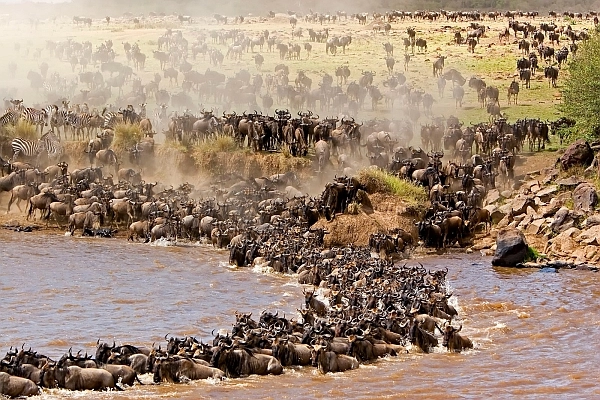
The annual migration:
Mostly called the Wildebeest migration, when in fact the Zebra's do the same thing and often lead the wildebeest. Triggered by the seasonal rains, more than a million wildebeest, 200,000 zebra and 300,000 Thomson’s gazelle gather to undertake their long trek to new grazing lands from the Southern Serengeti and Ngorongoro to Kenya and back into Tanzania again.It is the river crossings that are the most exciting as the herds gather on the river banks till one of them takes the plunge into the river and the rest start to follow creating a feast for crocodiles eagerly awaiting this phenomenon.
Another exciting time to visit is during the wildebeest rutting season which is a frenzied three week long bout of territorial conquests and mating. Replenishing the species is the brief population explosion that produces more than 8,000 calves a day before the 1,000 km pilgrimage begins.
Tanzania’s first and most famous park, the Serengeti, is renowned for its wealth of leopard and lion. The vast reaches of the park are a hiding place for the endangered black rhino and provide a protected breeding ground for the vulnerable cheetah, alongside the Serengeti’s thousands of other diverse species, from the 500 varieties of bird to 100 different types of dung beetle.
After the rains, the Serengeti’s magical golden horizon is transformed into an endless green carpet, flecked with wildflowers. The famous plains are interspersed with wooded hills, towering termite mounds, monumental rocky kopjes, and rivers lined with elegant acacia trees.
Tanzania’s first and most famous park, the Serengeti, is renowned for its wealth of leopard and lion. The vast reaches of the park are a hiding place for the endangered black rhino and provide a protected breeding ground for the vulnerable cheetah, alongside the Serengeti’s thousands of other diverse species, from the 500 varieties of bird to 100 different types of dung beetle.
After the rains, the Serengeti’s magical golden horizon is transformed into an endless green carpet, flecked with wildflowers. The famous plains are interspersed with wooded hills, towering termite mounds, monumental rocky kopjes, and rivers lined with elegant acacia trees.
Its far-reaching plains of endless grass, tinged with the twisted shadows of acacia trees, have made it the quintessential image of a wild and untarnished Africa. Its large stone kopjes are home to rich ecosystems, and the sheer magnitude and scale of life that the plains support is staggering. Large prides of lions laze easily in the long grasses, plentiful families of elephants feed on acacia bark and trump to each other across the plains, and giraffes, gazelles, monkeys, eland, and the whole range of African wildlife is in awe-inspiring numbers.
The park has varied zones in which each ecosystem is subtly different. Seronera in the center of the park is the most popular and most easily visited area. The Grumeti River in the Western Corridor is one of the locations for the dramatic river crossings during the wildebeest migration along with the Mara River in the north.
Aside from traditional vehicle bound safaris, hot-air ballooning over the Serengeti plains has become a safari rite-of-passage for travel enthusiasts. The flights depart at dawn over the plains and take passengers close over the awakening herds of wildebeest and zebra, gazelle and giraffe. The extra altitude allows guests to witness the striking stretches of plains punctuated only by kopjes.
Throughout the winter months of December to March, many animals are concentrated in the park's southern regions, near Ngorongoro. During the spring months of May or June, the vast herds of wildebeest and zebra start to head west in search of water, beginning a circuitous migration that takes some of them to shores of Lake Victoria, and others to northern areas and to Kenya's Maasai Mara park just across the border.
During the day it is warm, with temperatures ranging from 18C-25°C but it almost invariably rains, except in the very driest months of January and February. The year-round temperatures stay with in this range.
To search for the at-times elusive wildebeest migration, visit the Serengeti from December to July. To see predators, June to October are the best months. For the best chance of finding the migration, allow a minimum of three days, longer if possible.
Basic guide on when to go on safari in the Serengeti:
You can visit the Serengeti any time of the year, each season has its own special highlights… and the game is plentiful all year round.
January to March – wildebeest calving in the Southern plains & Ngorongoro
April to May – beginning of the migration, and the rains which covers the dust with a fine green blanket of grass! Excellent for photography.
June to July – migration moving west and northwards
August to October – excellent game viewing during the drier months, particularly around the central and northern areas
November to December – the return of the wildebeest through the central to the southern plains of the Serengeti to begin the whole process again.
Contact us now to book your This email address is being protected from spambots. You need JavaScript enabled to view it. now.
Serengeti Suggested Itineraries
Serengeti Safari Special Offers
The park has varied zones in which each ecosystem is subtly different. Seronera in the center of the park is the most popular and most easily visited area. The Grumeti River in the Western Corridor is one of the locations for the dramatic river crossings during the wildebeest migration along with the Mara River in the north.
Aside from traditional vehicle bound safaris, hot-air ballooning over the Serengeti plains has become a safari rite-of-passage for travel enthusiasts. The flights depart at dawn over the plains and take passengers close over the awakening herds of wildebeest and zebra, gazelle and giraffe. The extra altitude allows guests to witness the striking stretches of plains punctuated only by kopjes.
Throughout the winter months of December to March, many animals are concentrated in the park's southern regions, near Ngorongoro. During the spring months of May or June, the vast herds of wildebeest and zebra start to head west in search of water, beginning a circuitous migration that takes some of them to shores of Lake Victoria, and others to northern areas and to Kenya's Maasai Mara park just across the border.
During the day it is warm, with temperatures ranging from 18C-25°C but it almost invariably rains, except in the very driest months of January and February. The year-round temperatures stay with in this range.
To search for the at-times elusive wildebeest migration, visit the Serengeti from December to July. To see predators, June to October are the best months. For the best chance of finding the migration, allow a minimum of three days, longer if possible.
Basic guide on when to go on safari in the Serengeti:
You can visit the Serengeti any time of the year, each season has its own special highlights… and the game is plentiful all year round.
January to March – wildebeest calving in the Southern plains & Ngorongoro
April to May – beginning of the migration, and the rains which covers the dust with a fine green blanket of grass! Excellent for photography.
June to July – migration moving west and northwards
August to October – excellent game viewing during the drier months, particularly around the central and northern areas
November to December – the return of the wildebeest through the central to the southern plains of the Serengeti to begin the whole process again.
Contact us now to book your This email address is being protected from spambots. You need JavaScript enabled to view it. now.
Serengeti Suggested Itineraries
Serengeti Safari Special Offers