

For all those avid fishermen and women, Madagascar offers the best conditions and great catches. Charter a fishing yacht or stay in the lodges and enjoy daily outings.
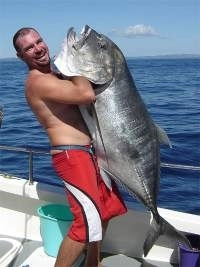 On the east coast, fishing is restricted mainly to the coastal lagoons, due to stormy seas and the absence of harbors. The main places for organizing deep-sea fishing excursions are Morondava, Nosy Be, Radama Islands and Ile Sainte Marie. Most of the local game fish species are found on the north west coast in abundance, including sailfish, giant trevally (GTs), dorado, king mackerel, barracuda, wahoo and Dog tooth tuna, amongst others. Reef and bottom fishing are equally good.
Fishing is a relatively underdeveloped industry in Madagascar and fish densities on the ground are quite high. The area in the north west is particularly renowned for its high sailfish count. Marlin are also plentiful, it seems mostly black, though they are often hooked by mistake on sailfish bait.
There are six species of crayfish that can be found in Madagascar, all of which are endemic. Prawns and shrimps are also farmed in Madagascar.
Water conditions around Nosy Be are fantastic, with very calm water, virtually no shore break and extremely high visibility. Large bays, headlands, rocky outcrops and small islands, many of which are uninhabited, characterize this area. It is an ideal introduction for new saltwater fishermen as well as a paradise for the more experienced, due to the sheltered and calm water conditions.
April through July/August seems to be peak sailfish time, with approximately 100 fish a day remaining near the surface. It is a sight to behold. These sailfish are quite big, many of them weighing over 100lbs. There is also abundant marlin, mostly black. Fishing, overall, hits its peak between June and November. December through March is the rainy season with heavy tropical rain that mainly falls at night, leaving the days clear. The fishing declines somewhat during the rainy season, but you’ll still get plenty of action in the water.
Tackle and flies:
For shore-based angling, we recommend a 10-wt and 6-wt outfit, both loaded with intermediate and floating lines. The 6-wt is perfect for the many smaller species on the flats, which provide great fun on light tackle! The 10-wt is more suitable for targeting larger fish and for the casting distance needed in the channels and along the edges of the coral flats. The flies we have used for shore-based angling have consisted mainly of chartreuse and white Clouser Minnows in sizes 2/0 and 4/0 (and when they say “Chartreuse’n white, chartreuse’n white, chartreuse’n white!” they really mean it!). Smaller charlies (sizes 2-10) in chartreuse, chartreuse and white, and pink and white also proved to be very handy as well.
For off shore angling, a 12-wt loaded with a full length DI-7 sinking line is probably most appropriate. A full length DI-7 is more suitable for deeper areas (10-15m) and handles better in currents. A sinking tip with a running line would be fine for targeting fish in water shallower than 10m, but we generally do not recommend it for deeper water. The flies we have successfully fished off shore have included Mega Clousers (size 6/0) and chartreuse and white Clouser Minnows in sizes 2/0-4/0. Make sure to stock up on flies, since large toothy fish quickly strip flies to bare hooks. Have fun!
April through July/August seems to be peak sailfish time, with approximately 100 fish a day remaining near the surface. It is a sight to behold. These sailfish are quite big, many of them weighing over 100lbs. There is also abundant marlin, mostly black. Fishing, overall, hits its peak between June and November. December through March is the rainy season with heavy tropical rain that mainly falls at night, leaving the days clear. The fishing declines somewhat during the rainy season, but you’ll still get plenty of action in the water.
Tackle and flies:
For shore-based angling, we recommend a 10-wt and 6-wt outfit, both loaded with intermediate and floating lines. The 6-wt is perfect for the many smaller species on the flats, which provide great fun on light tackle! The 10-wt is more suitable for targeting larger fish and for the casting distance needed in the channels and along the edges of the coral flats. The flies we have used for shore-based angling have consisted mainly of chartreuse and white Clouser Minnows in sizes 2/0 and 4/0 (and when they say “Chartreuse’n white, chartreuse’n white, chartreuse’n white!” they really mean it!). Smaller charlies (sizes 2-10) in chartreuse, chartreuse and white, and pink and white also proved to be very handy as well.
For off shore angling, a 12-wt loaded with a full length DI-7 sinking line is probably most appropriate. A full length DI-7 is more suitable for deeper areas (10-15m) and handles better in currents. A sinking tip with a running line would be fine for targeting fish in water shallower than 10m, but we generally do not recommend it for deeper water. The flies we have successfully fished off shore have included Mega Clousers (size 6/0) and chartreuse and white Clouser Minnows in sizes 2/0-4/0. Make sure to stock up on flies, since large toothy fish quickly strip flies to bare hooks. Have fun!